
Digital marketing has been transformed by generative artificial intelligence at a stunningly fast rate. AI can generate blog posts, build advertising copy, create automated email campaigns, and write social media posts in seconds. Marketers rushing to meet deadlines during a new brand launch campaign could certainly appreciate the value of that speed.
However, the value of AI-generated content is overshadowed by one key fact: AI does not comprehend reality.
Artificial intelligence generates word patterns based on past usage rather than thorough fact-checking. AI generates a likelihood of possible words to complete a sentence based on their probability of occurrence, which can result in producing false or misleading information with a high level of confidence.
This is what people mean when they say AI “hallucinates”, but Dimensions has a different perspective on it.
The team believes that technology is there to support rather than replace human expertise. All campaigns, metrics, and marketing recommendations go through human review because achieving sustainable growth requires accuracy, trust, and real-world knowledge.
Unfortunately, the trust is compromised when false information is being spread. Fast through WhatsApp, LinkedIn, word-of-mouth referrals, and so on. Thus, the distinction between AI-generated copy and human-validated marketing is more than technical; rather, it is something that shapes a company’s trust and long-term reputation in an evolving business landscape.
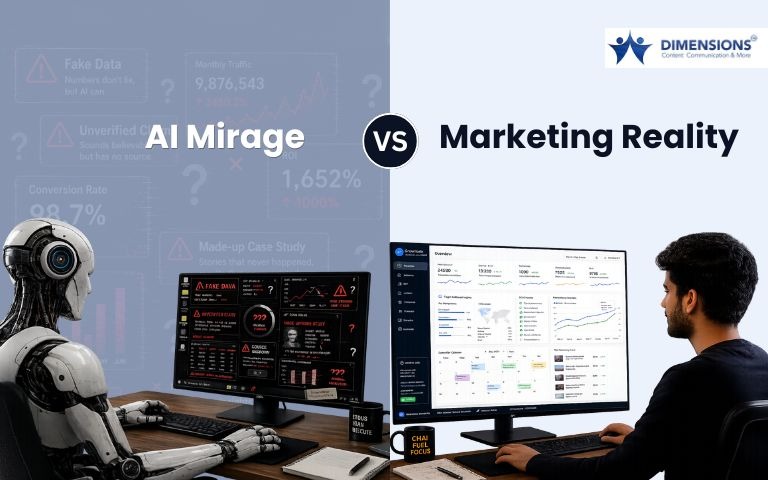
Demystifying the AI Mirage (What is Hallucination?)
An AI hallucination occurs when an AI produces false information and reports it with great certainty. It might involve creating a case study, fabricated data, a statistic, a testimonial, or a reference in the same manner as an author, but the AI does so on a much larger scale and at a much faster pace than a person would.
Why Does This Happen?
An AI model is a prediction engine, not a tested platform for verification. The AI models analyse tonnes of data and make predictions about which words will come up next. In other words, the results can sound very convincing, professional, and authoritative, even though they aren’t necessarily true.
Do not confuse this confidence with accuracy.
For instance, consider a B2B software company in Bangalore, which plans to launch a new service. They request AI assistance in creating a success story about their clients.
What the system generates looks like this:
“The customer XYZ boosted revenue by 72 per cent in six months, thanks to our solution,” including a statement of praise from a fake executive.
It sounds impressive. But there’s just one issue.
The client is not real. The executive is not real. The statistic is completely made up.
It is an AI hallucination.
It identified the elements of a good case study and created content that seemed to be real while not knowing whether the information was actually factual.
To an overworked team, smooth outputs from AI systems can seem ready for publication. But publishing unproven statements poses dangers of reputational risk, customer suspicion, and potential legal issues.
One such problem involves made-up statistics.
AI can confidently say that “78 per cent of marketers in India prefer AI-based advertising tools”, even though no research supports the assertion. Such statistics seem reliable solely because they fit into business speak very well.
But once made-up data is released, it could easily be disputed by competitors, the press, or a well-informed customer.
The point here is clear – the confidence of AI does not mean its statements are accurate.
Any claim must first be checked for accuracy. This is exactly what Dimensions Digital Marketing does to prevent any business from publishing claims that sound reliable but aren’t.
The High Cost of Automated Hallucinations in Marketing
Many businesses underestimate the risks associated with unverified AI-generated content. Yet the costs—financial, legal, and reputational—can be significant.
SEO and Search Visibility Risks
Search engines increasingly reward trustworthy content.
Google’s E-E-A-T framework—Experience, Expertise, Authoritativeness, and Trustworthiness—plays an important role in rankings. Content containing misleading information or unsupported claims weakens those trust signals.
Hallucinated content can damage visibility, reduce search performance, and weaken domain authority over time.
While any material produced through AI is not penalised, inaccurate information undermines credibility.
Many leading publishers have received flak for publishing errors created through AI technology. Inaccurate information leads to loss of credibility among readers.
Small businesses would find it especially difficult to recover their credibility.
Brand Reputation Damage
Consumers have become more fact-finding before buying anything.
Any company that makes claims about their performance, presents erroneous statistics, or manipulates results will be noticed.
Trust can take many years to build but can disappear overnight.
In India, reputation travels fast within the professional community, as well as through word-of-mouth. It doesn’t take much for one statement on LinkedIn or WhatsApp groups to become exaggerated.
Think of an educational brand presenting the number of placements with the help of an AI program. When consumers realise that the statistics are manipulated, all their efforts in building the brand’s reputation may go down the drain.
Wasted Advertising Spend
Mistakes in costly targeting are also possible in AI.
Improper interpretation of customer personas and false assumptions about audience preferences lead to campaigns targeting the wrong users.
Consider the example of a skincare brand in Mumbai using AI for Instagram advertising.
As a result of improper interpretation of keywords, the ads start targeting people interested in industrial machinery instead of beauty and wellness.
What’s the outcome?
Spending money on advertising without making any conversions.
Legal and Compliance Risks
In controlled industries such as finance, health care, and education, incorrect information can be more problematic. Untrue endorsements, exaggerated claims of effects, or promises lacking any basis might lead to legal issues.
Incorrect information could bring about negative publicity and investigations for companies.
In controlled industries, accurate information is not optional.
Hidden Operational Costs
There are also associated costs internally when it comes to addressing an incorrect marketing campaign.
Companies will need to update copywriting, verify claims, restructure messaging, and handle issues with customers. As companies clean up their image, competition continues to capture consumers’ attention.
An incorrect marketing campaign could result in several wasted weeks of momentum for your company.
Loss of Customer Trust
Ultimately, the greatest cost is lost trust.
Consumers rarely forget misinformation.
In India’s relationship-driven market, credibility often determines repeat business and referrals. Once confidence disappears, rebuilding it can take years
Why Dimensions Digital Marketing Doesn’t Hallucinate (The Human Edge)
Technology matters. Efficiency matters. But marketing without human judgement creates unnecessary risk.
At Dimensions, AI enhances workflows while experienced professionals remain in control. Rather than relying blindly on automation, the team uses AI strategically while ensuring every important decision is reviewed through a human lens.
Real-World Context Over Algorithms
Algorithms recognise patterns. Humans understand context.
Consumer behaviour, local culture, seasonal buying habits, and regional nuances all shape marketing success in ways automation cannot fully understand.
For instance, campaign messaging during Durga Puja in Kolkata requires emotional and cultural sensitivity that generic AI-generated content often misses.
An algorithm might produce festive messaging. Human strategists understand what genuinely resonates with audiences. This distinction prevents campaigns from appearing disconnected or culturally tone-deaf.
Rigorous Verification Processes
Every statistic, case study, testimonial, and performance claim undergoes verification before publication.
Nothing is published without review. Figures are checked, sources validated, and approvals confirmed.
Rather than relying on probability, Dimensions relies on data.
This significantly reduces the risk of misleading or inaccurate marketing.
Strategic Thinking Over Content Volume
AI is excellent at quantity. But successful marketing is not about producing endless content.
It is about creating purposeful communication that drives measurable outcomes. Dimensions prioritises high-intent strategies focused on qualified leads, customer retention, and long-term growth—not vanity metrics alone.
More content does not automatically mean better marketing. Relevant content delivers better results.
Subject-Matter Expertise
Complex sectors require specialist oversight. For industries such as fintech, healthcare, or education, subject-matter experts review technical claims to ensure compliance and accuracy.
Marketing should persuade. But it should always remain truthful.
Local Market Intelligence
Indian markets are highly diverse. Consumer preferences in Kolkata may differ significantly from those in Bengaluru, Delhi, or Tier-2 cities.
Dimensions incorporates regional understanding into campaigns to ensure messaging feels authentic, relevant, and effective.
This level of insight cannot be replicated through automation alone.
The Right Way to Use AI (Tool vs. Master)
The conversation should not be about rejecting AI. It should be about using it responsibly. At Dimensions Digital Marketing, AI serves as an assistant—not the decision-maker.
Use AI as an Assistant, Not a Strategist
AI works well for:
- Brainstorming ideas
- Producing first drafts
- Testing headline variations
- Generating copy alternatives
- Improving efficiency
However, final strategy, messaging, and factual claims remain human responsibilities.
AI can suggest. But humans decide.
Human-in-the-Loop Framework
A responsible workflow balances speed with accountability. At Dimensions, the process includes:
- Ideation: AI proposes concepts, while strategists align them with business goals.
- Drafting: AI speeds up content creation, while editors improve structure and tone.
- Verification: Researchers and specialists fact-check statistics and claims.
- Approval: Sensitive materials undergo compliance and client review before publication.
This ensures businesses benefit from AI efficiency without exposing themselves to unnecessary risk.
Practical Safeguards
Businesses should adopt clear controls, including:
- Requiring evidence for factual claims
- Using plagiarism and fact-checking tools
- Maintaining editorial approval systems
- Flagging high-risk promises involving healthcare, finance, or legal outcomes
No claim should be published without verification.
Continuous Learning and Training
These tools keep improving at a fast pace. Therefore, constant training is vital. The Dimensions team is constantly upgrading its processes and staying up to date with industry best practices.
Choose Wisely
In this day and age, there is nothing but quality content around. But factual accuracy makes you stand out from the rest. Genetic algorithms make processes faster, more creative, and shorter. They lack, however, critical decision-making, cultural sensitivity, and planning. Ultimately, they cannot be an independent source of fact-checking.
In a country as interconnected and business-oriented as India, a single mistruth can ruin your reputation permanently. Relying on technologies that focus on predicting language rather than verifying information could cost your business its integrity. Make a choice to promote your company through a fact-based approach, a responsible and human-powered marketing strategy. A strategy that will prove itself true in action—rather than statistically.
Call to Action
Want to identify weaknesses within your present marketing approach?
Contact Dimensions Digital Marketing for an entirely free reality-check audit designed to align with your business objectives. Learn from previous case studies on how human-vetted marketing strategies can deliver sustainable success.
Let us craft a strategy based on proven facts, not guesses.