
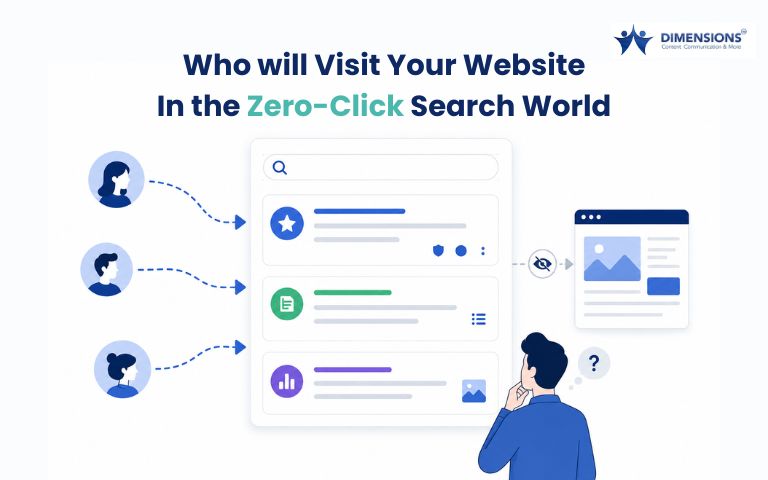
The internet once thrived on a single transaction where the user searched and clicked on links out of their curiosity, and the website owners thrived on this organic traffic. Today’s search underwent a massive shift where AI-driven assistants prioritise user efficiency. The goal has shifted from SEO to “zero-click searches”. AI now summarises results, delivering immediate results directly on the result page. This shift might look like an extinction event to the creators. This was associated with flattening charts, rising impressions but plunging clicks. However, the larger picture is that the causal click is dying while the remaining traffic is exponentially more valuable. This makes the game shift from focusing on high volume to high intent.
The Psychology of Zero – Click Bypassers
Since AI readily answers all your questions, why would anyone still click?
The answer to this question is trust. AI is very effective in summarising information very quickly. This significantly reduces search time. However, this might lead to incorrect information without a consistent source attribution. For high-stakes decisions, complete AI dependence is never enough. In such cases credibility matters more than convenience. Such researchers look out for authoritative sources with detailed information. They do represent a tiny section of the search traffic, but at least they arrive with a stronger intent, making them the most valuable.
People Who Still Visit Your Website
For individuals at high stakes, like doctors, lawyers, and business executives who are researching important information, AI-generated summaries are starting points. In such cases documentation, evidence and primary sources are extremely important. A medical professional would not want a chatbot’s interpretation of a research paper but the very original research paper itself. A lawyer would not look for a paraphrase of a regulation but an actual government publication. A brand operating in scientific and technical sectors is the most valuable, and organic traffic for your website.
Visitors who are done with their discovery phase are already done using AI for understanding the available solutions and evaluating vendors. Now their purpose is to purchase a product or maybe download a software, i.e., perform their ultimate task.
Users seeking functionality still need websites. Websites where the product itself is a financial calculator, property valuation system, or geological data dashboard cannot be replaced by AI-generated texts. Utility will always create non-negotiable traffic.
Another category of visitors to a website are the brand loyalists. They are anyway not searching for results. They are going to search your website name and will be on your page for your brand value and not for information. They will explore your latest products and services.
Content connoisseurs are the ones that go beyond the algorithmically generated content and want a personal experience and detailed case studies. Chatbots often give very predictable data. Some people are in for human storytelling and not machine-generated content.
SERP Blueprint: What Do These Personas Actually Click?
Currently, the search engine results page is no longer a marketplace of links. AI now answers all your queries instantaneously. Curiosity-driven clicks are slowly disappearing. However, the remaining traffic is important decision-makers who rely on trustworthy sources or maybe are ready to complete a purchase. Some of them would be there to use specialised tools that are irreplaceable by AI. Some of them could be individuals who already have trust in your brand and seek original insights. These people are looking for perspectives beyond AI-generated data.
| Persona | What They Need | Why They Click |
|---|---|---|
| High-Stakes Verifier | Proof and authority | AI is not accountable |
| Action-Oriented Transactor | Purchase or conversion | Action requires a destination |
| Interactive Utility Seeker | Functionality | Tools cannot be summarised. |
| Brand Loyalist | Familiar expertise | Trust outweighs convenience |
| Content Connoisseur | Human perspective | Originality cannot be synthesised. |
The Problem with SEO-Only Growth
The shift has led to the organic traffic being more selective, which forces a brand to build in visibility, engagement and long-term growth.
- Winning in the zero-click era requires brand building through push-based distribution
- Just to rank on the first page of a search engine does not guarantee website visits.
- If your content is not engaging, it will fail to create an impact even though it is exceptional.
- Email, communities, newsletters, and social media create direct relationships that are not dependent on search engines.
Pivot To Push Marketing
Push marketing ensures that the user encounters you even before you are searching. In the AI era, brands are no longer waiting patiently post-publishing. Instead, they actively place their most valuable ideas, insights, and assets directly in front of their ideal audience. They manufacture awareness before intent exists. By the time the user enters a search query, the brand is already present in their mind.
Meta Ads
Unlike earlier, Meta platforms like Instagram and Facebook are not just mere transactional channels that drive immediate sales. Paid socials have become more strategic. Brands must wisely use them for the distribution of intellectual capital.
A consulting firm that publishes a groundbreaking market report might optimize a blog post and hope the right audience discovers it through search. But if they use Meta’s advanced targeting capabilities to place that report directly in front of decision-makers in specific industries, they will have a greater ROI.
Today, when zero-search is the new search norm, brands should no longer wait for discovery but should engineer it and reach out to people who matter. Over time, repeated exposure creates familiarity, familiarity creates trust, and trust leads to preference
YouTube: Trusting The Human Presence
In an AI-dominated text world, a human-led video becomes one of the strongest remaining competitive advantages. Trust is not built only through information but through presence. There is something profoundly persuasive about seeing a real person explain a complex idea. A face communicates confidence. A voice conveys conviction. This makes YouTube and other video advertising so powerful in the zero-click era. A well-produced video does far more than transfer information.
The Synergy: How Push Marketing Creates Brand Loyalists
Aggressive push marketing can create brand loyalists, who are the most valuable personas in the zero-click ecosystem. They are not generic searchers. They already know what their intent is. When users deliberately search for a brand by name, the search engine is no longer choosing between competitors. The user already has already done that, making the brand no longer optional. It is becoming the single most durable moat in digital marketing.
The Next Chapter of Search
The next generation digital winners will not be those who master Google’s algorithm better but those who become impossible to ignore.
In the zero-click era, websites still remain pivotal, but their role is evolving. Instead of being the starting point of every customer journey, they are becoming the destination where high-intent audiences arrive, informed and ready to engage.
So, the goal has shifted from “How to get more clicks?” to “How to become the brand people deliberately choose?” Brands that answer the question are going to define the next chapter of digital marketing.